


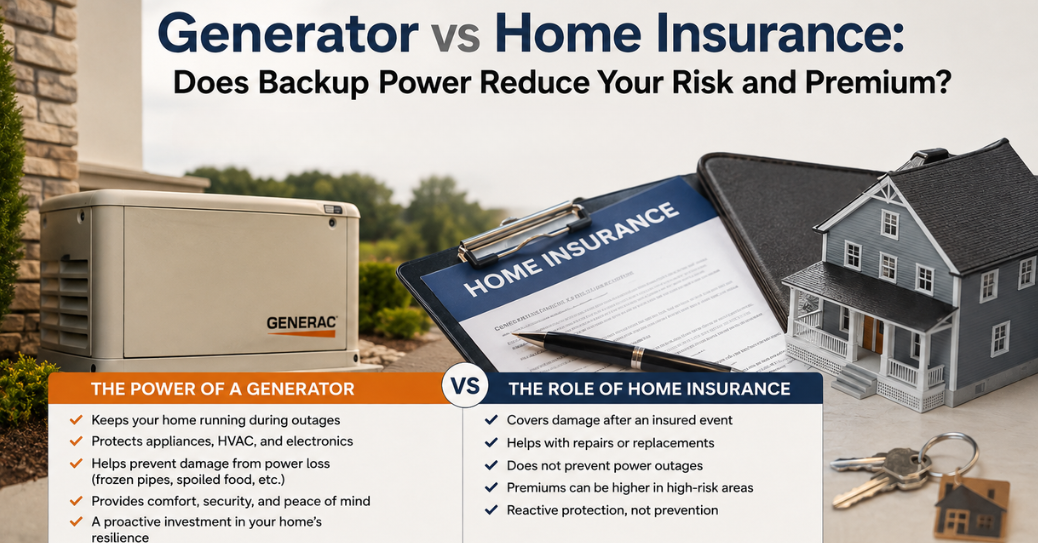
A power outage can cost you more than comfort. It can cost you your pipes, your food, your sump pump, and eventually your insurance premium. Homeowners across the country now ask one question every storm season: Generator vs Home Insurance: Does Backup Power Reduce Your Risk and Premium? This article breaks down the real numbers, the real discounts, and the real risk reduction that a generator brings to your policy, helping you understand whether backup power can protect your home and potentially reduce insurance costs.
Why Power Outages Now Matter to Your Insurance Company
Power outages are no longer rare events. U.S. electricity customers experienced an average of 11 hours of power outages in 2024, nearly twice as many as the annual average across the previous decade, according to Energy Information Administration data. Hurricanes drove most of that spike. Hurricanes accounted for 80% of those lost hours in 2024, with major storms like Helene and Milton knocking out power for millions of homes.
Insurers track these trends closely. Every extended outage raises the odds of a claim. Frozen pipes burst. Sump pumps fail. Basements flood. Food spoils. Furnaces stop. Each of these events turns into a payout, and payouts push premiums higher for everyone in the risk pool. This is exactly why insurers now reward homeowners who install standby power.
Extreme weather drives this shift in a measurable way. From 2000 to 2021, 83% of major power outages in the United States were attributed to extreme weather, including severe storms, hurricanes, and other climate-related incidents. That percentage keeps insurers focused on prevention, not just payout.
Does a Generator Actually Lower Your Home Insurance Premium?
Yes, in many cases it does. Insurance carriers often offer 5% to 10% discounts for homes equipped with a backup power source, such as a Generac standby unit. The logic behind the discount is simple. A generator cuts the chance of a weather-related claim, so the insurer lowers your rate to reflect that lower risk.
Multiple providers confirm similar numbers. Automatic standby generators powered by natural gas or propane may receive 5% discounts from most insurers, and homeowners must permanently install the unit to qualify. Briggs & Stratton reports the same trend across its dealer network, noting that many insurance companies reduce homeowners’ premiums typically by 5% for those with propane or natural gas-powered automated standby generators.
Not every carrier offers this credit, though. Real homeowner discussions confirm mixed results. One forum thread noted that Farmers and Nationwide representatives said they do not currently offer such a discount, while other regional carriers do. This means your savings depend heavily on your specific insurer, your state, and your policy type. Always call your agent before you buy a unit.
Portable vs Standby Generators: Only One Qualifies
Insurance discounts almost never apply to portable generators. Portable generators typically do not qualify because they are not permanently installed, automatic, or integrated into the electrical system. A standby unit wires directly into your home, switches on within seconds, and runs your whole house. That permanence is what insurers reward.
If you already own a portable unit for camping or short outages, it still helps during emergencies. It just will not lower your premium. For homeowners weighing both options, this comparison of solar battery vs backup generator systems breaks down which setup fits different budgets and climates.
Generator Discount Table: What Insurers Actually Offer
| Generator Type | Typical Premium Discount | Insurer Requirement |
|---|---|---|
| Whole-home standby (natural gas/propane) | 5% to 10% | Permanently wired, automatic transfer switch |
| Portable gasoline generator | 0% | Not eligible, not permanently installed |
| Solar battery backup system | 0% to 5% (varies by carrier) | Permanent installation, sometimes tied to fire-prevention credits |
| Diesel standby unit (larger homes) | 5% to 10% | Professional install, code compliance |
These numbers shift year to year and state to state, so treat the table as a general guide rather than a guarantee. Some carriers bundle the generator discount into a broader “loss mitigation” credit alongside storm shutters, sump pump backups, and water leak sensors.
How Much Does a Standby Generator Actually Cost in 2026?
Cost remains the biggest barrier for most households. In 2026, the average installed cost of a Generac standby generator ranges from $8,000 to $16,000, depending on system size and installation complexity. Smaller units cost less if you buy through bulk retailers. Entry-level 14kW systems without installation can run closer to $3,800, based on recent retail listings, though installation, permits, and gas line work add thousands more.
Homeowners often ask whether the insurance discount offsets the purchase price. It rarely does on its own. A 5% discount on a $1,800 annual premium saves about $90 a year. That means it takes decades to recover an $8,000 investment through insurance savings alone. The real value comes from combining the discount with avoided claims, spoiled-food losses, and property protection during long outages.
Cost Comparison Table: Standby Generator Sizes
| Generator Size | Typical Use Case | Estimated Installed Cost (2026) |
|---|---|---|
| 10kW – 14kW | Essential circuits, small home | $5,500 – $9,000 |
| 16kW – 20kW | Mid-size home, most appliances | $8,000 – $12,000 |
| 22kW – 26kW | Whole-home coverage, larger properties | $12,000 – $16,000+ |
What Risks Does a Generator Actually Reduce?
Insurers do not offer discounts out of goodwill. They offer them because generators measurably cut specific claim categories. The most common outage-related claims include frozen pipe bursts, sump pump failure floods, spoiled food losses, and fire hazards from unsafe alternative heating. Claims related to frozen pipes, basement flooding, fire hazards from unsafe heating attempts, spoiled food, and mold growth often occur during extended outages.
A standby generator keeps your sump pump running, which prevents basement flooding during storms. It keeps your furnace or heat pump running, which prevents frozen and burst pipes in winter. It keeps refrigeration running, which prevents spoiled food claims. Each of these categories represents real dollar losses that insurers track across thousands of policies every year.
Smart home technology adds another layer of protection when paired with backup power. Homeowners increasingly connect security systems, water sensors, and thermostats to their generators. This guide on how a generator protects your smart home during a power outage explains exactly how that integration works.
Regional Risk: Where Generators Matter Most
Not every state faces the same outage risk, and insurers price policies accordingly. South Carolina experienced the longest service interruptions of any state in 2024, at nearly 53 hours, largely due to Hurricane Helene. Florida and North Carolina followed closely behind with similar storm damage to transmission lines and substations.
Hawaii tells a different story. Hawaii saw more frequent interruptions, averaging 4.4 outages per customer compared to the U.S. average of 1.5, driven by volcanic activity and generation issues rather than hurricanes. Meanwhile, Arizona, South Dakota, North Dakota, and Massachusetts experienced less than two hours of service interruptions in 2024, on average.
These regional gaps directly shape which homeowners benefit most from a generator investment. Florida homeowners facing annual hurricane threats should read this dedicated breakdown on choosing a backup generator for Florida hurricane season. California residents dealing with wildfire-driven shutoffs should check this guide on the best generator for California wildfires and power outages.
State-by-State Outage Snapshot (2024 Data)
| State | Average Outage Duration (2024) | Primary Cause |
|---|---|---|
| South Carolina | ~53 hours | Hurricane Helene |
| Florida | Well above national average | Hurricanes Helene and Milton |
| Hawaii | Under 10 hours, but frequent | Volcanic activity, generation issues |
| Arizona, Massachusetts | Under 2 hours | Stable grid, low storm exposure |
Does a Generator Increase Property Value Too?
Insurance savings are only part of the financial picture. A properly installed standby generator also raises resale appeal. Buyers in storm-prone regions now treat backup power as a near-essential feature, similar to a security system or updated roof. This detailed analysis on whether home backup generators increase property value this year walks through appraisal data and buyer demand trends.
Real estate agents in hurricane and wildfire zones increasingly list standby generators as a selling point. Homes with permanent backup power often sell faster during active storm seasons, when buyers feel outage risk most acutely.
Standby Generators for Specific Climates
Climate shapes generator choice as much as it shapes insurance pricing. Cold-climate homes need units built for winter startup and snow load clearance. Homeowners researching options in colder regions should review this roundup of the best standby generators for German homes, which covers cold-weather reliability standards relevant to many northern U.S. climates as well.
Coastal and wildfire-prone regions need different priorities entirely, including corrosion resistance, fuel availability during evacuation orders, and quick automatic start during rolling blackouts.
Steps to Get Your Insurance Discount Approved
Getting the discount requires more than just buying a generator. Insurers ask for documentation, and skipping steps can delay or void your credit.
| Step | What to Do |
|---|---|
| 1. Call your insurer first | Confirm the exact discount percentage and eligibility rules before you buy |
| 2. Choose a standby unit | Portable generators do not qualify for any discount |
| 3. Hire a licensed installer | Most insurers require professional installation and permits |
| 4. Keep all documentation | Save invoices, permits, and inspection records for your agent |
| 5. Submit proof to your agent | Discounts rarely apply automatically; you must request the credit |
What Home Insurance Still Will Not Cover
A generator reduces risk, but it does not replace insurance, and insurance does not replace a generator. Standard homeowners policies generally exclude damage caused directly by a power outage itself. Standard home insurance policies do not cover damage caused by power outages, including damage to appliances, electronics, and other items.
Your policy also typically will not cover the generator unit itself unless damage comes from a covered peril. If your generator is damaged due to a covered peril under your homeowner’s insurance policy, such as fire, lightning, theft, or a storm, your insurance may cover repair or replacement costs. Routine mechanical failure or normal wear usually falls outside your coverage entirely.
This gap matters. A generator prevents outage-caused losses like frozen pipes and spoiled food. It does not insure itself against theft or storm damage without proper coverage riders. Ask your agent whether your policy needs a specific endorsement for the unit’s replacement value.
Generator vs Insurance: The Real Comparison
| Factor | Generator | Home Insurance |
|---|---|---|
| Prevents damage | Yes, actively prevents outage-related losses | No, only reimburses after damage occurs |
| Upfront cost | $5,500 to $16,000+ | Ongoing annual premium |
| Covers generator theft/storm damage | No | Yes, under covered perils |
| Reduces premium | Yes, typically 5% to 10% | N/A |
| Restores power during outage | Yes, within seconds | No |
The two tools work best together, not as substitutes. A generator lowers the odds you ever file a claim. Insurance protects you financially when something still goes wrong despite your precautions.
Frequently Asked Questions
Does every insurance company offer a generator discount?
No. Some major carriers offer 5% to 10% credits, while others offer none at all. Always confirm directly with your agent before purchase.
Do portable generators qualify for any insurance discount?
Almost never. Insurers require a permanently installed, automatic standby system to approve the credit.
How long does it take to recover the generator cost through insurance savings?
Insurance savings alone rarely repay the cost quickly. A 5% discount on an average premium saves roughly $80 to $120 a year, so the real payoff comes from avoided claims and property protection.
Will insurance pay to repair my generator if it breaks down?
Only if the damage results from a covered peril like fire, lightning, theft, or storm. Normal mechanical failure typically falls outside coverage.
Which states benefit most from a standby generator?
Hurricane-prone states like Florida and South Carolina, plus wildfire-prone regions like California, see the highest outage risk and the most insurance-related benefit.
Final Words
A backup generator will not make your insurance company hand you a huge discount. It will, however, cut your real-world risk of the exact claims that drive premiums up in the first place. Outages now last longer than they did a decade ago, and storms keep getting named earlier each season. A standby generator protects your pipes, your basement, your food, and your peace of mind. Pair it with the right insurance policy, confirm your discount in writing, and you cover both sides of the risk equation. That combination, not one tool alone, gives your home real protection when the grid goes down.




 Get survival, travelling and auto tips, follow new technology trends, entertainment stories and world events with PeekTimes.