


German electricity prices sit near 35 cents per kWh right now. That figure sits far above the European average. Grid outages stay rare, yet storms, heatwaves, and grid maintenance still knock out power for hours at a time. While German homeowners are mainly focused on short-term backup solutions, regions with harsher storm conditions, such as Florida, show why reliable backup generators have become essential for protecting homes during extended outages. More German homeowners now buy a standby generator as insurance against these gaps. This guide walks through the best standby generators for German homes, real pricing data, legal rules, and running costs. It uses fresh, up-to-date figures from Bundesnetzagentur, BDEW, and leading German retailers.
Germany’s grid outage time vs other countries
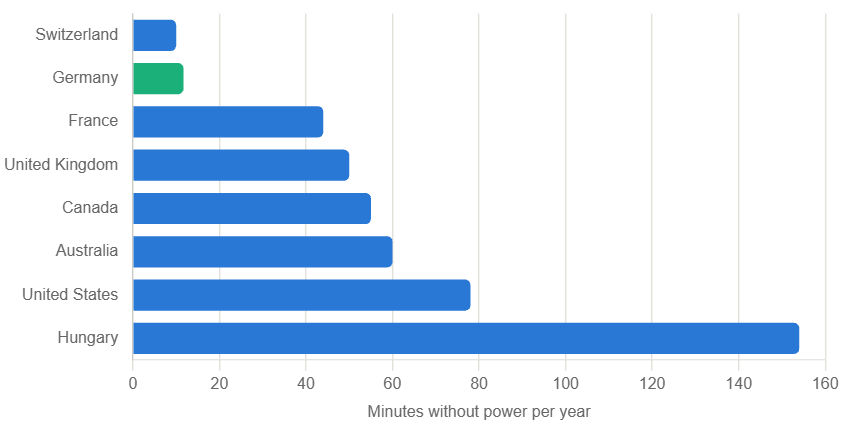
Germany’s grid stays among the most reliable worldwide, second only to Switzerland.
Why German Homeowners Need a Standby Generator Now
Germany runs one of the most reliable power grids in the world. The Bundesnetzagentur reports an average SAIDI value of 11.7 minutes for 2024. That number beats the ten-year average of 12.7 minutes. Only Switzerland records a lower outage time in Europe. Still, reliability does not mean zero risk. Storms like Sabine and Zeynep caused regional blackouts lasting several hours. Rural areas connected to older grid infrastructure face longer restoration times than cities. Homeowners with heat pumps, home offices, or medical equipment cannot afford even a short outage.
Rising electricity costs add another layer to this decision. Household electricity averaged 39.6 cents per kWh in 2025, according to Clean Energy Wire. New customer tariffs dropped to roughly 34.87 cents per kWh after recent government subsidies on grid fees. Even with this relief, German households still pay far more than neighbors in France or Poland. A standby generator does not lower your daily bill. It does protect you from costly disruption during outages, freezer spoilage, and remote work downtime.
Solar panel owners face a specific gap too. Most rooftop solar systems shut down automatically during a grid outage for safety reasons. Without a battery or generator backup, a sunny rooftop stays useless during a blackout. This pushes many solar households toward a hybrid backup solution that pairs a generator with battery storage.
Types of Standby Generators Available in Germany
German retailers stock four main generator categories for residential use. Each type suits a different budget, noise tolerance, and power need. The table below breaks down the core differences.
| Generator Type | Typical Power Range | Noise Level | Best For | Price Range (EUR) |
|---|---|---|---|---|
| Portable petrol generator | 1,000–5,500 watts | 68–75 dB(A) | Short outages, camping, garden tools | 250–900 |
| Inverter generator | 1,000–3,000 watts | 55–60 dB(A) | Sensitive electronics, quiet neighborhoods | 500–1,800 |
| Diesel generator | 3,000–10,000 watts | 70–80 dB(A) | Long runtime, workshops, farms | 800–3,500 |
| Fixed standby generator (Netzersatzanlage) | 5,000–20,000 watts | 65–75 dB(A) | Whole-home backup, automatic switchover | 3,000–15,000 |
Portable petrol units dominate the entry-level market. They start fast, cost little upfront, and run most household appliances. Inverter models produce cleaner power and run quieter. This makes them a safer pick for laptops, routers, and medical devices. Diesel generators cost more initially but burn less fuel per kWh over long runtimes. Fixed standby systems connect directly to the home’s electrical panel. They switch on automatically within seconds of an outage, similar to systems common in the United States.
Best Standby Generators for German Homes Right Now
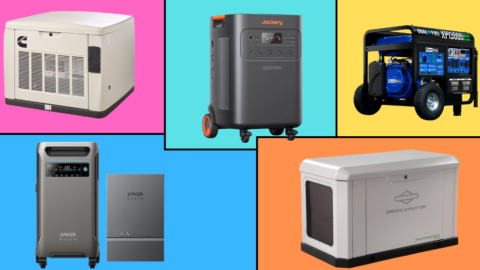
Retail comparison data from current German test portals highlights several standout models. The list below reflects current bestsellers based on power output, noise rating, and value for money.
Honda EU22i Inverter Generator
The Honda EU22i remains a top pick for quiet, reliable backup power. It delivers up to 2,200 watts of continuous output. Its Eco Throttle system adjusts engine speed to match load automatically. This cuts fuel use and keeps noise low during light loads. Runtime reaches 3.5 hours at full load and stretches further at partial load. Many buyers choose this unit for home offices and refrigeration backup. The price sits higher than most competitors, yet reliability justifies the premium for many households.
EBERTH GG1-ER5500 Petrol Generator
The EBERTH GG1-ER5500 targets buyers who need higher continuous output. It delivers 5 kW of continuous power through its heavy-duty outlet. A 25-liter fuel tank supports 9 to 11 hours of runtime per fill. This model suits larger homes running a fridge, freezer, pump, and lighting together. Noise output stays around 69 dB(A), comparable to a normal conversation. Buyers on tighter budgets find this model delivers strong value per watt.
Zipper ZI-STE1200IV Inverter Generator
The Zipper ZI-STE1200IV suits apartment dwellers and small households. It weighs only 12.8 kilograms, so one person can carry it easily. Maximum output reaches 1.2 kW, enough for a laptop, router, and small appliances. This model runs on standard petrol or E10 fuel. Its compact size makes storage simple in a garage or basement.
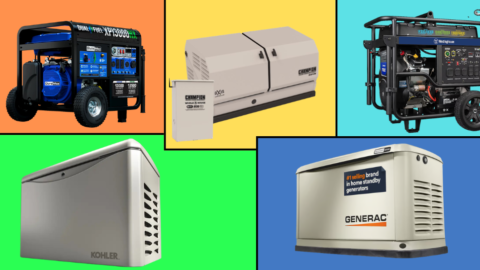
Kohler and Generac Fixed Standby Systems
Kohler and Generac supply fixed standby generators through specialist German installers. These systems connect permanently to a home’s fuse box through an automatic transfer switch. Natural gas or LPG powers most units, removing the need for manual refueling. Installation requires a certified electrician and, in many cases, a building permit review. Whole-home coverage starts around 8 kW and scales up to 20 kW for larger properties. This option suits homeowners who want zero manual intervention during an outage.
Comparison Table: Top Models at a Glance
| Model | Type | Continuous Output | Runtime per Tank | Noise Level | Approx. Price |
|---|---|---|---|---|---|
| Honda EU22i | Inverter, petrol | 2,000 W | 3.5–8 hours | 57 dB(A) | €1,400–1,800 |
| EBERTH GG1-ER5500 | Conventional, petrol | 5,000 W | 9–11 hours | 69 dB(A) | €650–900 |
| Zipper ZI-STE1200IV | Inverter, petrol | 1,200 W | 4–6 hours | 60 dB(A) | €300–450 |
| Kohler 8–20kW Standby | Fixed, gas/LPG | 8,000–20,000 W | Continuous with gas line | 65–68 dB(A) | €6,000–15,000 installed |
| Generac Guardian Series | Fixed, gas/LPG | 8,000–22,000 W | Continuous with gas line | 65–70 dB(A) | €6,500–16,000 installed |
Key Factors Before Buying a Generator in Germany
Choosing the right generator depends on more than price alone. German buyers should weigh power output against actual home consumption. Most households only need enough capacity to run essentials during an outage. This includes a fridge, a few lights, a router, and a heating circulator pump.
| Factor | What to Check | Why It Matters |
|---|---|---|
| Power output (watts) | Match to combined appliance load | Overloading causes shutdown or damage |
| Fuel type | Petrol, diesel, LPG, or natural gas | Affects cost, storage, and refueling ease |
| Noise rating (dB) | Check local Ruhezeiten rules | High noise risks neighbor complaints |
| Runtime per tank | Hours at full and partial load | Determines how often you must refuel |
| Automatic transfer switch | Manual or automatic changeover | Automatic systems restore power faster |
| Portability | Weight and wheel kits | Matters for renters and small properties |
| Certification | CE marking, VDE compliance | Required for safe home use in Germany |
Households with a heat pump need higher wattage than those with gas heating. Electric vehicle owners should factor in charging needs separately, since most portable generators cannot support fast charging. Buyers in flats or terraced housing should prioritize inverter models due to stricter noise expectations from neighbors.
German Rules and Regulations for Standby Generators
Germany does not require a formal permit for most portable generators used in private homes. This applies to occasional use of a mobile unit for personal backup power. Larger, permanently installed systems face more oversight than portable units. Fixed Netzersatzanlagen may fall under review by the local building authority (Bauamt) and environmental office (Umweltamt).
Every generator operator must still follow Section 22 of the Federal Immission Control Act (BImSchG). This law governs air quality and noise control regardless of generator size. The Technical Instructions on Noise (TA Lärm) sets reference limits for acceptable sound levels near residential buildings. Local Ordnungsamt offices can enforce these limits if neighbors file a noise complaint.
Connecting a generator to your home’s internal wiring adds further legal requirements. Grid operator rules like VDE-AR-N 4100 govern how a generator interacts with the household network. A licensed electrician must install any transfer switch or direct connection to the fuse box. Plugging a generator into a wall socket without proper isolation breaks safety rules. This practice, sometimes called “backfeeding,” risks fire and can injure utility workers on the grid.
Diesel-fueled stationary units also fall under the Water Resources Act (Wasserhaushaltsgesetz) due to fuel storage rules. Emissions limits under TA Luft apply mainly to larger commercial installations rather than small residential units. Homeowners planning a large fixed system should still consult their local Umweltamt before installation. This step avoids costly retrofits after a system already sits in the ground.
Where to Legally Place Your Generator
Placement matters as much as generator choice. Never run a petrol or diesel generator inside a closed room without ventilation. Carbon monoxide poisoning kills hundreds of people worldwide every year, mostly from indoor generator use. Outdoor placement needs enough distance from windows, doors, and neighboring buildings. Exhaust routing rules require fumes to disperse away from occupied spaces and adjoining property lines.
Garden sheds with open-air ventilation work well for portable units. Fixed standby systems typically sit on a concrete pad outside the home, similar to an air conditioning condenser. Installers position these units to minimize noise transfer toward bedrooms and neighboring windows.
Running Costs: What a Generator Actually Costs to Operate
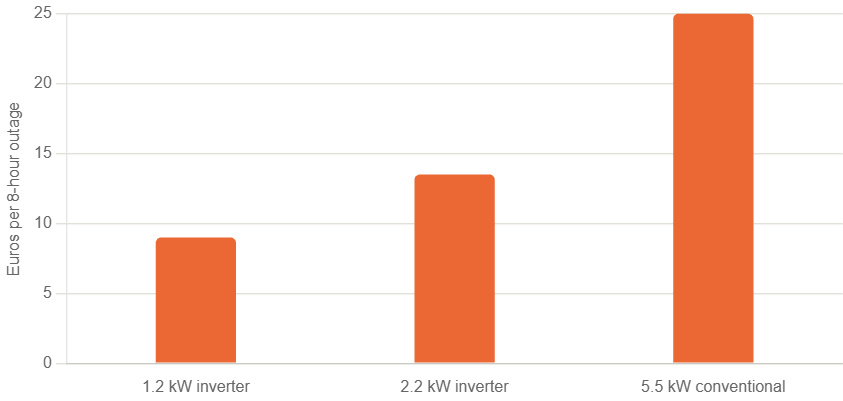
Fuel costs make up the largest ongoing expense for any standby generator. Petrol generators burn roughly 1.2 to 5 liters per hour depending on load and size. At German petrol prices near €1.70 per liter, an 8-hour outage can cost €15 to €70 in fuel alone. Diesel generators burn less fuel per kWh produced, which lowers long-term running costs for frequent use.
| Generator Size | Fuel Use per Hour | Cost per Hour (Petrol) | Cost per 8-Hour Outage |
|---|---|---|---|
| 1.2 kW inverter | 0.5–0.8 L | €0.85–1.35 | €7–11 |
| 2.2 kW inverter | 0.8–1.2 L | €1.35–2.00 | €11–16 |
| 5.5 kW conventional | 1.2–2.5 L | €2.00–4.25 | €16–34 |
| 8–20 kW fixed (LPG/gas) | Gas metered | Varies by tariff | Continuous, tariff-based |
Fixed standby systems running on natural gas avoid manual refueling entirely. Owners pay through their existing gas connection at standard household gas tariffs. This convenience comes with a much higher upfront installation cost compared to portable units.
Maintenance adds a smaller but steady cost across every generator type. Oil changes, spark plug replacement, and air filter checks run roughly €50 to €150 per year for portable units. Fixed systems often carry an annual service contract with a certified technician, typically €150 to €300 per year.
Fuel cost per 8-hour outage by generator size
Petrol, Diesel, or Battery: Choosing the Right Fuel Type
Petrol generators start easily and cost the least upfront. They work well for occasional outages and short-term backup needs. Fuel storage carries some risk, since petrol degrades after several months without a stabilizer additive.
Diesel generators cost more initially but handle heavier loads for longer periods. Diesel fuel stores longer than petrol without degrading as quickly. Farms, larger properties, and workshops often prefer diesel for this durability.
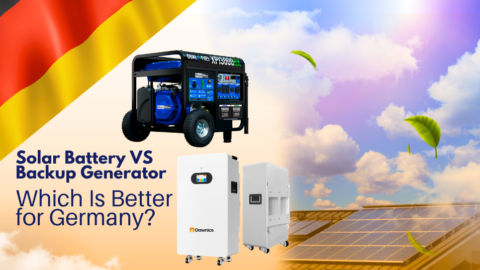
Battery and solar hybrid systems offer a cleaner, quieter alternative gaining popularity in Germany. These systems store energy from solar panels or the grid in advance. During an outage, the battery discharges instantly without noise, fumes, or refueling. Upfront costs run higher than fuel generators, often starting around €4,000 for a home battery setup. Battery systems suit homeowners already running solar panels who want full outage independence.
Installation: DIY Portable Units vs Professional Fixed Systems
Portable generators need no professional installation for basic use. Buyers can unbox, add oil and fuel, and start the engine within minutes. Connecting a portable unit to household circuits still requires a qualified electrician and a proper transfer switch. This step prevents dangerous backfeeding into the public grid.
Fixed standby systems always require professional installation from a certified electrician. The process includes site assessment, gas line connection, concrete pad preparation, and transfer switch wiring. Installation typically takes one to three days depending on system size and site complexity. Homeowners should request quotes from at least two certified installers before committing.
Frequently Asked Questions
Do I need a permit for a standby generator in Germany? Most portable generators for private, occasional use need no formal permit. Fixed, permanently installed systems may require review from your local Bauamt or Umweltamt. Always confirm requirements with your local authority before installing a large system.
How loud can a generator legally run in a residential area? Germany has no single national decibel limit for home generators. The Technical Instructions on Noise (TA Lärm) sets reference guidance that local authorities enforce. Quiet hours, called Ruhezeiten, typically apply between 10 PM and 6 AM and during midday hours on Sundays.
Can I plug a generator directly into a wall socket? No, this practice is dangerous and against electrical safety rules. It can backfeed electricity into the grid and injure utility workers. Always use a certified transfer switch installed by a licensed electrician.
What size generator do I need for a typical German home? A 2,000 to 3,000 watt unit covers a fridge, lights, and a router for most apartments. Larger homes with a heat pump or well pump often need 5,000 watts or more. Fixed whole-home systems typically start at 8,000 watts.
How much does a whole-home standby generator cost installed in Germany? Installed costs for fixed systems range from roughly €6,000 to €16,000. This price depends on power output, fuel type, and site complexity. Portable units cost far less but require manual operation during outages.
Is a battery backup better than a generator? Battery systems run silently and produce no emissions during operation. They cost more upfront and offer limited runtime without solar recharging. Many households now combine both for maximum flexibility during extended outages.
How often should I test my standby generator? Run portable units for 15 to 30 minutes every one to two months. This habit keeps the engine and fuel system in working order. Fixed systems often include an automatic self-test feature on a weekly schedule.
Final Words
German homes rarely lose power for long, yet even short outages disrupt work, food storage, and comfort. Rising electricity prices make every household think harder about energy resilience. A standby generator offers practical insurance against storms, grid maintenance, and unexpected failures. Portable inverter models suit renters and small households on a budget. Fixed standby systems suit larger properties that want automatic, hands-free backup power. Whichever option you choose, follow German noise, safety, and connection rules closely. A properly installed generator protects your home without risking fines or safety hazards. Compare models carefully, match power output to real household needs, and invest in a system built for German conditions.



 Get survival, travelling and auto tips, follow new technology trends, entertainment stories and world events with PeekTimes.