


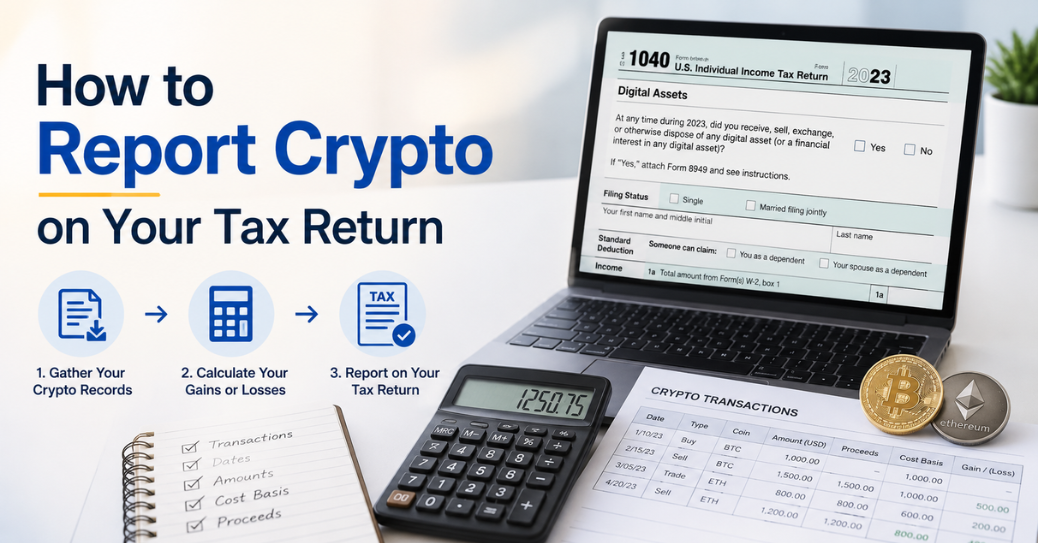
Reporting crypto on your tax return trips up even experienced filers. The IRS now asks every taxpayer a digital asset question. Exchanges report your trades directly through Form 1099-DA. Getting the forms wrong invites penalties and audit risk. This guide walks through exactly how to report crypto on your tax return. You get the right forms, the right steps, and clear examples. No guesswork, just a straightforward path from trades to filed return.
Start With the Digital Asset Question
Every Form 1040 filer answers a digital asset question first. This question sits right on page one of your return. It asks whether you received, sold, or disposed of digital assets. You must answer yes or no honestly, regardless of amount. Buying crypto with cash and holding it still requires a yes. Selling, trading, or spending crypto also requires a yes. Simply holding crypto without any activity allows a no answer.
Answering this question incorrectly raises red flags immediately. The IRS cross-references your answer against broker-reported data. A mismatch between your answer and your 1099-DA invites scrutiny. Take this single checkbox seriously before moving to the rest of your return.
Which Forms You Need to Report Crypto
Different crypto activities require different tax forms. The table below breaks down which form matches which activity.
| Activity | Form Required | Where It Goes |
|---|---|---|
| Selling or trading crypto | Form 8949 | Attaches to Schedule D |
| Summarizing capital gains | Schedule D | Attaches to Form 1040 |
| Mining or staking income (hobby) | Schedule 1 | Attaches to Form 1040 |
| Mining as a business | Schedule C | Attaches to Form 1040 |
| Crypto received as wages | Form W-2 | Reported by employer |
| Crypto paid to contractors | Form 1099-NEC | Issued by payer |
| Broker-reported proceeds | Form 1099-DA | Issued by exchange |
Most individual investors only need Form 8949 and Schedule D. Miners, stakers, and crypto-paid workers need additional forms.
Reporting Capital Gains: Form 8949 and Schedule D
Form 8949 lists every taxable crypto disposal individually. Each row includes the asset, dates, proceeds, and cost basis. You separate short-term and long-term transactions onto different sections. Short-term covers assets held one year or less. Long-term covers assets held more than one year.
Schedule D then summarizes the totals from Form 8949. It combines your short-term and long-term gains or losses. This summary flows directly onto your Form 1040. If your 1099-DA already reports accurate cost basis, filing gets simpler. You may skip Form 8949 in that specific case. Any correction or adjustment still requires the full form.
Here is a simplified example of one Form 8949 entry. You sold 0.25 Bitcoin on a specific date. Proceeds equal $12,000, and cost basis equals $9,000. Your gain equals $3,000 for that single line. Multiply this process across every disposal you made during the year.
Reporting Crypto Income: Mining, Staking, and Airdrops
Crypto income follows a separate reporting path from capital gains. Mining, staking rewards, and airdrops count as ordinary income. You report this income at fair market value when received. This value also becomes your cost basis going forward.
Hobby miners and stakers report income on Schedule 1. This form covers additional income outside your regular wages. Business miners operating at scale use Schedule C instead. This allows you to deduct related business expenses too. Electricity costs and equipment depreciation become deductible on Schedule C. Hobby activity does not allow these deductions.
Consider a practical example using staking rewards. You earn $2,000 worth of ETH from staking over the year. You report $2,000 as income on Schedule 1. If you later sell that ETH for $2,500, a new event occurs. Your cost basis starts at $2,000, the amount already taxed. Your capital gain on the sale equals just $500.
How Form 1099-DA Changes Your Filing Process
Form 1099-DA now arrives from every centralized exchange you use. It reports your gross proceeds directly to the IRS. This mirrors how Form 1099-B works for stock trades. The form gives the IRS visibility into your trading activity. This visibility did not exist in earlier tax years.
Cost basis reporting rolls out gradually across broker platforms. Brokers report basis mainly for assets acquired more recently. Older holdings may lack basis data on your 1099-DA entirely. You remain responsible for supplying accurate basis in that case. Compare your own records against the 1099-DA before filing. Discrepancies between the two increase your audit risk significantly.
Not every crypto activity generates a 1099-DA. DeFi trades and wallet-to-wallet swaps often go unreported by brokers. You must still report these transactions yourself. The absence of a form never removes your reporting obligation.
Step-by-Step: Reporting Crypto on Your Return
Follow this sequence to report your crypto activity correctly.
Step 1: Gather all transaction records. Pull data from every exchange, wallet, and DeFi platform you used during the year.
Step 2: Separate disposals from income events. Sales and trades go toward capital gains. Mining, staking, and airdrops go toward ordinary income.
Step 3: Calculate gain or loss on each disposal. Subtract cost basis from proceeds for every sale or trade.
Step 4: Classify each gain as short-term or long-term. Check the holding period for every individual transaction.
Step 5: Complete Form 8949. List every disposal with dates, proceeds, and cost basis included.
Step 6: Transfer totals to Schedule D. Summarize your short-term and long-term totals here.
Step 7: Report income on Schedule 1 or Schedule C. Choose based on whether your activity counts as a hobby or business.
Step 8: Answer the digital asset question on Form 1040. Confirm your answer matches your actual activity for the year.
Step 9: Reconcile against any 1099-DA received. Compare broker-reported proceeds against your own calculated figures.
Step 10: File your return. Submit through tax software, a preparer, or directly with the IRS.
Reporting NFT Transactions
NFTs follow the same general framework as other crypto assets. Selling an NFT for a profit creates a capital gain. This gets reported on Form 8949 just like a coin sale. Some NFTs may qualify as collectibles under IRS guidance. Collectibles held over one year face a flat 28% rate instead. This differs from standard long-term capital gains rates.
Creators who mint and sell NFTs report that income differently. This counts as ordinary income, not a capital gain. Royalties from secondary NFT sales also count as ordinary income. Report this income on Schedule C if you operate as a creator business.
Reporting Crypto Losses
Losses reduce your overall tax bill and deserve careful reporting. Capital losses first offset capital gains dollar for dollar. Any remaining loss can offset up to $3,000 of ordinary income yearly. Losses beyond that amount carry forward to future tax years. This carryforward continues indefinitely until fully used.
Report losses using the same Form 8949 and Schedule D process. A loss simply produces a negative number on that line. Combine all gains and losses together before applying the annual limit. This nets your total crypto tax position for the year.
Common Filing Mistakes to Avoid
Certain mistakes appear repeatedly on crypto tax returns. Avoiding them keeps you compliant and reduces audit exposure.
Forgetting to report DeFi swaps ranks among the top errors. These trades rarely generate a 1099-DA from any broker. Treating wallet transfers as taxable sales also causes problems. Moving crypto between your own wallets triggers no tax event. Mixing up short-term and long-term holding periods costs money too. A single miscounted day can shift your applicable tax rate. Skipping the digital asset question entirely invites unnecessary scrutiny. Always answer it, even with minimal crypto activity during the year.
Using Tax Software to File Crypto
Most filers use crypto tax software before completing their return. These tools generate Form 8949 and Schedule D automatically. They then export directly into TurboTax, TaxAct, or H&R Block. This removes manual data entry from the filing process entirely. Software also reconciles your records against incoming 1099-DA forms. This catches mismatches before you submit your return.
Filers with complex situations may still need professional help. High transaction volume, DeFi complexity, or NFT businesses benefit from expert review. A crypto-specialized CPA can catch issues software might miss.
FAQs About Reporting Crypto on Your Tax Return
Do I need to report crypto if I didn’t sell anything? You still answer the digital asset question either way. No sale or trade usually means no capital gain to report.
What form reports crypto capital gains? Form 8949 lists individual transactions. Schedule D summarizes the totals for your Form 1040.
How do I report staking income? Report it as ordinary income on Schedule 1 for hobby activity. Use Schedule C if you operate staking as a business.
Do I need Form 8949 if I received a 1099-DA? Not always. If the reported cost basis is accurate, you may skip it. Any correction still requires the form.
What happens if I don’t report crypto income? You risk penalties, interest, and increased audit likelihood. The IRS matches broker data against your filed return.
Can I deduct crypto losses from my regular income? Yes, up to $3,000 of net losses per year. Excess losses carry forward to future tax years.
Do I report crypto received as a gift? Receiving a gift is not taxable immediately. You inherit the original cost basis for future sales.
How are NFT sales reported differently from coins? The process is similar, using Form 8949 for sales. Some NFTs may face a 28% collectibles rate instead.
Final Words
Reporting crypto correctly protects you from penalties and stress. Start with the digital asset question on Form 1040. Use Form 8949 and Schedule D for every capital gain. Report mining, staking, and airdrop income separately as ordinary income. Reconcile your records against any 1099-DA you receive. Keep detailed records for every wallet and exchange you use. When your situation gets complex, bring in a tax professional. Accurate reporting today prevents costly problems down the road.







 Get survival, travelling and auto tips, follow new technology trends, entertainment stories and world events with PeekTimes.