



Crypto taxes confuse millions of investors every year. In the U.S., the IRS treats cryptocurrency and other digital assets as property, meaning selling, trading, or exchanging crypto can create a taxable gain or loss. New broker reporting rules and Form 1099-DA are also making crypto tax reporting more important than ever. This crypto tax guide explains exactly how to calculate cryptocurrency taxes, determine your cost basis, calculate capital gains and losses, and understand what you may need to report. You’ll get clear examples, practical calculations, and the latest IRS rules, without complicated jargon or unnecessary fluff.
Why Crypto Taxes Matter More Than Ever
The crypto tax landscape changed dramatically this year. Centralized exchanges must now issue Form 1099-DA to every user. This form reports your gross proceeds directly to the IRS. The agency now sees your crypto activity almost like stock trades. Erin Collins, the IRS National Taxpayer Advocate, flagged this shift in a report to Congress. She noted that many crypto holders remain out of compliance. Most of this happens due to confusion, not intentional fraud. Still, the IRS expects accurate reporting from every taxpayer. Ignorance of the rules will not protect you from penalties. Understanding your obligations now saves you stress later.
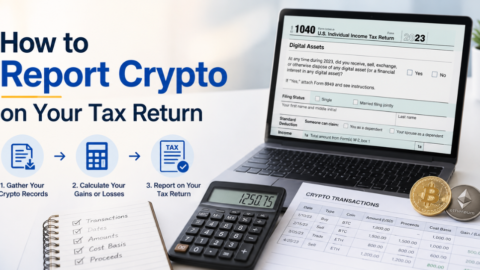
Every Form 1040 filer must answer the digital asset question. This applies even if you only bought a small amount. The IRS has no minimum threshold for crypto reporting. One transaction can trigger a reporting requirement. Skipping this question raises red flags during an audit. Honesty on this single checkbox matters more than people realize.
How the IRS Classifies Cryptocurrency
The IRS classifies cryptocurrency as property, not currency. This classification comes from IRS Notice 2014-21. It treats Bitcoin, Ethereum, and other tokens like stocks or real estate. This distinction shapes every tax calculation you make. Selling crypto for cash triggers a capital gain or loss. Trading one coin for another also counts as a taxable event. Spending crypto on goods or services counts too. Even swapping a token in a DeFi protocol counts as a sale. The IRS views this as disposing of property you own.
This property classification differs from how most people think about money. Spending dollars from your bank account triggers no tax event. Spending Bitcoin from your wallet almost always does. This gap catches new investors off guard constantly. Understanding this rule early prevents costly filing mistakes later.
Taxable Events vs Non-Taxable Events
Not every crypto transaction creates a tax obligation. Knowing the difference helps you plan trades wisely. The table below breaks down common scenarios clearly.
| Transaction Type | Taxable? | Tax Treatment |
|---|---|---|
| Selling crypto for USD | Yes | Capital gain or loss |
| Trading one crypto for another | Yes | Capital gain or loss |
| Spending crypto on goods | Yes | Capital gain or loss |
| Receiving mining rewards | Yes | Ordinary income |
| Receiving staking rewards | Yes | Ordinary income |
| Receiving an airdrop | Yes | Ordinary income |
| Buying crypto with USD | No | No tax event |
| Holding crypto in a wallet | No | No tax event |
| Transferring crypto between your own wallets | No | No tax event |
| Donating crypto to charity | No | May qualify for a deduction |
This table shows a simple pattern worth remembering. Disposing of an asset almost always triggers tax consequences. Earning new crypto also creates taxable ordinary income. Simply buying or holding never creates a tax bill.
How to Calculate Capital Gains on Crypto
Calculating your capital gain follows a simple formula. Subtract your cost basis from your sale proceeds. The result is your gain or loss for that trade. Cost basis includes the purchase price plus any fees. Sale proceeds include the amount received minus transaction fees.
Here is the basic formula written out plainly:
Capital Gain = Sale Price − Cost Basis
Consider a practical example to see this in action. You buy one Bitcoin for $40,000, including fees. Six months later, you sell it for $55,000. Your capital gain equals $15,000 for that single trade. Since you held it under a year, short-term rates apply. This gain gets taxed at your ordinary income rate.
Now consider a second scenario with a longer holding period. You buy Ethereum for $2,000 and hold it for 18 months. You later sell it for $3,200, producing a $1,200 gain. Because you held over one year, long-term rates apply instead. These rates sit well below most ordinary income brackets.
Short-Term vs Long-Term Capital Gains Tax Rates
The holding period changes your tax rate dramatically. Assets held one year or less count as short-term. Assets held more than one year qualify as long-term. This single distinction can save you thousands of dollars.
Short-term capital gains get taxed as ordinary income. Rates range from 10% up to 37%. Your total taxable income determines which bracket applies. Long-term capital gains receive far more favorable treatment. Rates sit at 0%, 15%, or 20% depending on income.
The table below shows the current long-term capital gains brackets.
| Filing Status | 0% Rate | 15% Rate | 20% Rate |
|---|---|---|---|
| Single | Up to $49,450 | $49,451 to $545,500 | Above $545,500 |
| Married Filing Jointly | Up to $98,900 | $98,901 to $613,700 | Above $613,700 |
These thresholds rose due to annual inflation adjustments. High earners should also watch the Net Investment Income Tax. This adds a 3.8% surtax on investment income above certain levels. The threshold sits at $200,000 for single filers. Married couples filing jointly face this surtax above $250,000. This surtax stacks on top of your regular capital gains rate.
Short-term rates follow the standard current income tax brackets below.
| Filing Status | Bracket Range | Rate |
|---|---|---|
| Single | Up to $11,925 | 10% |
| Single | $11,926 to $48,475 | 12% |
| Single | $48,476 to $103,350 | 22% |
| Single | $103,351 to $197,300 | 24% |
| Single | $197,301 to $250,525 | 32% |
| Single | $250,526 to $626,350 | 35% |
| Single | Above $626,350 | 37% |
This comparison makes one thing obvious immediately. Holding crypto past the one-year mark often cuts your tax bill significantly. Many experienced investors plan sales around this exact rule.
How Crypto Income Gets Taxed Differently
Not all crypto activity creates capital gains or losses. Mining, staking, and airdrops generate ordinary income instead. The IRS taxes this income at fair market value. This value gets measured the moment you receive the asset. You then owe ordinary income tax on that value immediately.
Here is how this plays out with staking rewards. You earn 0.5 ETH from staking, worth $1,500 at receipt. You report $1,500 as ordinary income for that tax year. If you later sell that ETH for $1,800, things get interesting. Your cost basis becomes the $1,500 you already reported as income. Your capital gain on the sale equals just $300. This prevents the IRS from taxing the same value twice.
Mining rewards follow this exact same logic. Airdropped tokens also follow this same two-step process. Report income first, then track basis for future capital gains. Missing this step leads to overpaying or underpaying your taxes.
NFTs and Collectibles: A Special Tax Category
NFTs carry unique tax treatment that catches many people off guard. The IRS may classify certain NFTs as collectibles. This happens when the NFT represents an underlying collectible asset. Collectibles held over one year face a flat 28% rate. This rate applies instead of the standard long-term capital gains rates. IRS Notice 2023-27 addresses this NFT classification directly.
Creators selling NFTs report that income as ordinary income. Royalties earned from secondary NFT sales also count as ordinary income. These rules make NFT tax planning more complex than typical crypto trades. Anyone active in the NFT space should track this carefully.
Form 1099-DA and What It Means for You
Form 1099-DA changes crypto tax reporting permanently. Every centralized exchange operating in the United States must issue it. This includes major platforms like Coinbase, Kraken, and Gemini. The form reports your gross proceeds directly to the IRS. This mirrors how Form 1099-B works for stock trades.
Cost basis reporting rolls out gradually alongside this change. Brokers must report basis for assets acquired starting this tax year. Older assets may still require manual basis tracking on your part. Exchange records often miss basis data for older wallet transfers. This makes personal recordkeeping essential even with 1099-DA in place.
Not receiving a 1099-DA does not excuse you from reporting. You must report all digital asset activity regardless of forms received. DeFi trades, peer-to-peer sales, and wallet-to-wallet swaps rarely get reported by brokers. The responsibility to track and report these falls entirely on you.
Step-by-Step: How to Calculate Your Crypto Taxes
Follow this process to calculate your crypto tax liability accurately.
Step 1: Gather every transaction record. Pull data from every exchange, wallet, and DeFi platform you used. Include buys, sells, trades, transfers, and income events.
Step 2: Determine the cost basis for each asset. Cost basis equals your purchase price plus any fees paid. Track this separately for each lot you acquire.
Step 3: Identify each taxable event. Separate sales, trades, and spending events from simple transfers. Only taxable events require gain or loss calculations.
Step 4: Calculate gain or loss per transaction. Subtract cost basis from proceeds for every disposal. Note the holding period for each one.
Step 5: Classify gains as short-term or long-term. Assets held over one year qualify for long-term rates. Everything else falls under short-term treatment.
Step 6: Total your ordinary income from crypto. Add up mining, staking, and airdrop income separately. This gets taxed at your regular income rate.
Step 7: Report everything on the correct forms. Use Form 8949 and Schedule D for capital gains. Report crypto income on Schedule 1 or Schedule C.
Choosing a Cost Basis Method
The IRS allows several methods for calculating cost basis. Your chosen method affects your final tax liability significantly. Here are the most common approaches investors use.
| Method | How It Works | Best For |
|---|---|---|
| FIFO (First In, First Out) | Sells your oldest coins first | Default method for most taxpayers |
| LIFO (Last In, First Out) | Sells your newest coins first | Reducing gains in a rising market |
| HIFO (Highest In, First Out) | Sells your most expensive coins first | Minimizing taxable gains |
| Specific Identification | You choose which exact coins to sell | Maximum control over tax outcomes |
FIFO remains the default method without specific identification. Specific identification requires detailed records for each transaction. Many crypto tax software tools now automate this tracking. Choosing the right method can meaningfully lower your tax bill.
Crypto Tax Loss Harvesting
Crypto currently has no wash-sale rule under federal law. This creates a unique opportunity for savvy investors. You can sell a losing asset and immediately rebuy it. This locks in a tax deduction without losing market exposure. Stock investors cannot do this due to wash-sale restrictions.
Here is how this strategy works in practice. You hold Solana purchased at $180, now worth $120. You sell it, realizing a $60 loss per coin. You immediately rebuy Solana at the same $120 price. Your position stays intact, but you now claim the loss. This loss can offset other capital gains on your return. Up to $3,000 of net losses can offset ordinary income yearly. Excess losses carry forward to future tax years indefinitely.
Lawmakers have discussed closing this wash-sale loophole for years. Watch for potential legislative changes in future tax seasons.
Common Crypto Tax Mistakes to Avoid
Many taxpayers make the same errors year after year. Avoiding these mistakes keeps you compliant and reduces audit risk.
Forgetting DeFi transactions ranks among the most common errors. Swaps on decentralized exchanges rarely generate 1099 forms. Yet the IRS still expects you to report them. Failing to track cost basis across multiple wallets also causes problems. Moving assets between wallets does not reset your cost basis. Many investors mistakenly treat transfers as new purchases.
Ignoring small transactions creates cumulative reporting gaps over time. Every trade counts, even ones worth a few dollars. Miscalculating holding periods also leads to overpaying taxes unnecessarily. A single day can shift a trade from short-term to long-term. Double-check purchase and sale dates before filing your return.
Crypto Tax Software and Tools
Manual tracking becomes unrealistic for active traders quickly. Crypto tax software connects to exchanges and wallets automatically. These tools calculate gains, losses, and income across all platforms. Popular options integrate directly with Form 8949 preparation. Using software reduces errors and saves significant time each season. Many platforms also reconcile your data against incoming 1099-DA forms. This reconciliation step catches discrepancies before the IRS does.
FAQs About Crypto Taxes
Do I owe taxes if I only bought crypto and never sold it? No, buying and holding crypto creates no taxable event. Taxes apply only when you sell, trade, or spend it.
Is transferring crypto between my own wallets taxable? No, moving assets between wallets you own triggers no tax. Your original cost basis carries over to the new wallet.
How does the IRS know about my crypto trades? Exchanges now issue Form 1099-DA directly to the IRS. This gives the agency visibility similar to stock brokerages.
What happens if I don’t report my crypto taxes? You risk penalties, interest, and potential audit exposure. The IRS actively cross-references broker data against filed returns.
Can I deduct crypto losses on my tax return? Yes, capital losses offset capital gains and up to $3,000 of income. Excess losses carry forward to future tax years.
Are stablecoin trades taxable events? Yes, trading crypto for a stablecoin counts as a disposal. You must calculate gain or loss on that trade.
Do I pay taxes on crypto gifts I receive? No, receiving a gift is not taxable at that moment. You inherit the giver’s original cost basis instead.
What tax rate applies to crypto held under a year? Short-term gains get taxed at ordinary income rates. These range from 10% to 37% based on your income.
Final Words
Crypto taxes no longer live in a gray area. The IRS now tracks digital assets like traditional securities. Form 1099-DA closes many gaps that once existed. Understanding cost basis, holding periods, and income rules matters greatly. Accurate records protect you from penalties and audit stress. Start tracking every transaction as soon as it happens. Use software if your trading activity spans multiple platforms. When in doubt, consult a qualified crypto tax professional. Getting this right today saves real money and real headaches later.






 Get survival, travelling and auto tips, follow new technology trends, entertainment stories and world events with PeekTimes.